


As part of the podcast series, “ArtsAbly in Conversation,” Diane Kolin interviewed Eric Whitmer, a third-year Ph.D. student in Musicology at the University of Michigan.
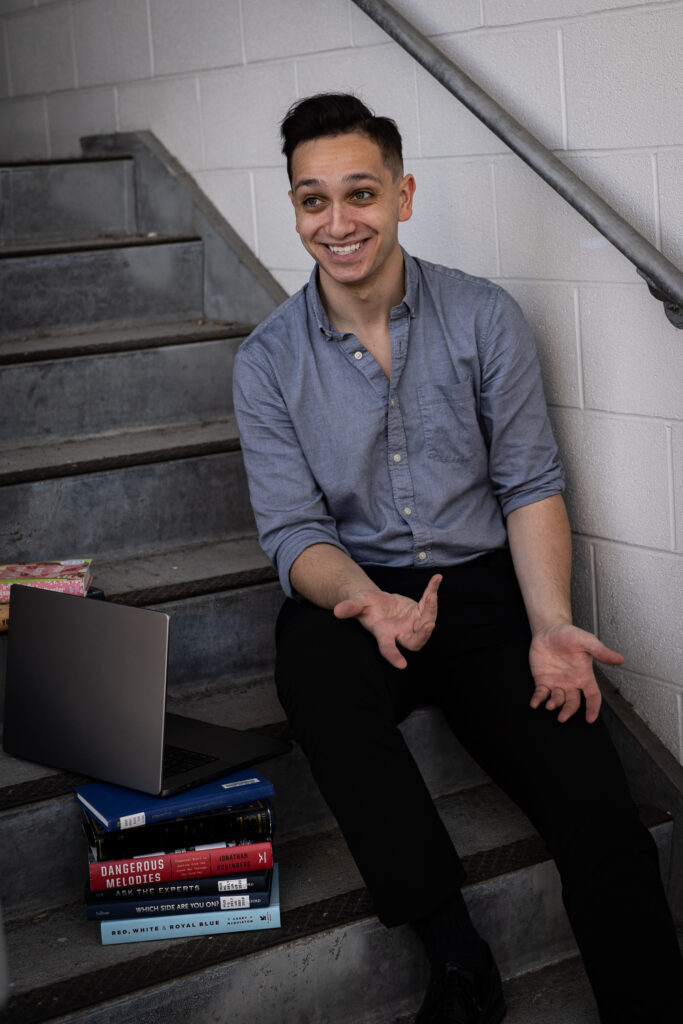
This post presents the resources that Eric Whitmer mentioned during the conversation. The episode will be published soon.
Eric Whitmer
Eric Whitmer (they/he) is an interdisciplinary musician, artist, and scholar interested in the intersections of music, ethical rhetoric, and community. Eric performs as the percussionist in Sono Trio and is the Resident Carillonist for Grosse Pointe Memorial Church and Kirk in the Hills Presbyterian Church. At the University of Michigan, they are a third-year Ph.D. student in Musicology with Historical Emphasis and are pursuing a certificate in Digital Studies. Their musicological work focuses on American musical culture in the 20th and 21st centuries related to music’s role in community development, anecdotal rhetoric, and group identity. Additionally, Eric is a member of the Digital Accessible Futures Lab and regularly pursues research related to disability studies. In their limited spare time, Eric can be found baking some new and challenging pastry, behind a camera taking a portrait of a friend, or on a paddleboard in one of Michigan’s many great (pun intended) lakes.
What is a carillon?
A carillon is a musical instrument of bells. Typically housed in a purpose-built bell tower or belfry, a carillon consists of at least 23 harmonically-tuned bells. The cup-shaped bells are hung fixed in a frame (what a campanologist would call “dead” rather than “swinging”). A carillonneur or carillonist (someone who plays the carillon) then operates a mechanism not unlike an organ, which signals an intricate system of internal clappers or external hammers to sound the bells.
The Orff Approach
The Orff Approach, or Orff-Schulwerk, is a child-centered music education method by Carl Orff that integrates music, speech, movement, and drama, focusing on active participation, improvisation, and creativity through play, using simple percussion instruments like xylophones and bells, teaching musical concepts experientially before notation, much like how children learn language. It’s an inclusive, joyful way for all children to develop musicality by exploring rhythms, melodies, and patterns through familiar activities like songs, games, and storytelling.
Learn more about the Orff Approach
Critical Disability Studies: Models of Disability
Critical Disability Studies define models of disability, such as, but not limited to, medical, social, identity, minority or charity models. Each frame explains the concept of disability and influences societal attitudes, policies, and support systems. Each model is described in terms of its underlying assumptions – for example, the medical model focuses on disability as a personal health issue requiring medical intervention, while the social model emphasizes societal barriers as the primary source of disability.
Learn more about the models of disability
Mesures extraordinaires by Joseph Straus
Abordant le handicap comme une construction culturelle plutôt que comme une pathologie médicale, cet ouvrage étudie l'impact du handicap et des concepts de handicap sur les compositeurs, les interprètes et les auditeurs handicapés, ainsi que sur le discours sur la musique et les œuvres musicales elles-mêmes. Pour les compositeurs handicapés - comme Beethoven, Delius et Schumann - la conscience du handicap influe fortement sur la réception critique. Pour les interprètes handicapés - comme Itzhak Perlman et Evelyn Glennie - l'interprétation du handicap et l'interprétation de la musique sont profondément liées. Pour les auditeurs handicapés, des corps et des esprits extraordinaires peuvent donner naissance à de nouvelles façons de comprendre la musique. Dans les histoires que les gens racontent sur la musique, et dans les histoires que la musique elle-même raconte, le handicap a longtemps joué un rôle central mais méconnu. Certaines de ces histoires sont des récits de dépassement - le triomphe de l'esprit humain sur l'adversité - mais d'autres sont des récits plus nuancés d'adaptation et d'acceptation de la vie avec un corps ou un esprit non normatif. De toutes ces manières, la musique reflète et construit le handicap.
More information about the book
AMS Music and Disability Study Group
The AMS Music and Disability Study Group is an official Study Group of the American Musicological Society composed of scholars with interdisciplinary interests in music and disability studies. The group pursues many scholarly initiatives, including conference papers and panels, articles, and books. It also advocates for inclusion and accessibility for scholars, particularly within their professional organizations. Finally, it advocates for the inclusion of all students, regardless of bodymind and diagnosis, and works on designing pedagogy and teaching in flexible and inclusive ways, so that all students feel welcome and flourish, and so that fewer “retrofit” accommodations need to be implemented for their optimal learning.
Visit the AMS Music and Disability Study Group website
Jacob Nissly
Jacob (Jake) Nissly joined the San Francisco Symphony as Principal Percussion in 2013. He is chair of the Percussion Department and professor of percussion at the San Francisco Conservatory of Music. He is also a regular coach at the New World Symphony. He previously taught at the Eastman School of Music and Cleveland Institute of Music. He has served as a percussion coach for the Aspen Music Festival since 2019, National Youth Orchestra-USA, Verbier Festival, and others. Nissly can be heard on recordings with the San Francisco Symphony and the Cleveland Orchestra. He also played drum set on the St. Louis Symphony’s Grammy award-winning recording of John Adams’s City Noir.In 2019, Nissly premiered Adam Schoenberg’s percussion concerto Losing Earth with the San Francisco Symphony. He has performed the piece with the New Zealand Symphony Orchestra and the Omaha Symphony and will perform it with the Nuremberg Symphony in 2026.
Molly Joyce
Molly Joyce is a composer and performer whose work explores disability as a creative source. Described by The Washington Post as “one of the most versatile, prolific, and intriguing composers working under the vast new-music dome,” her music has also been praised by The New York Times for its “serene power” and by Vulture as “unwavering… enveloping.” Joyce frequently performs on an electric vintage toy organ—an instrument she found on eBay that physically suits her body and conceptually embodies her engagement with disability in sound.
Julius Eastman
Julius Eastman was an American composer. He was among the first composers to combine the processes of some minimalist music with other methods of extending and modifying his music as in some experimental music. He thus created what he called “organic music”. In compositions like Stay On It (1973), his melodic motifs were not unlike the catchy refrains of then pop music. He studied performance and composition in New York and contributed to new music scenes in New York, Buffalo, and Chicago, touring and recording as a performer and enjoying many performances of his own music. As a conductor, musician, and vocalist, he had a close artistic relationship with Arthur Russell and worked briefly with Meredith Monk and Pierre Boulez. His voice is that of Peter Maxwell Davies’ Mad King on Nonesuch Records. He worked in a variety of musical styles, including classical, jazz, and crossover.
Learn more about Julius Eastman
Pauline Oliveros
Pauline Oliveros’ life as a composer, performer and humanitarian was about opening her own and others’ sensibilities to the universe and facets of sounds. Her career spanned fifty years of boundary dissolving music making. In the ’50s she was part of a circle of iconoclastic composers, artists, poets gathered together in San Francisco. In the 1960’s she influenced American music profoundly through her work with improvisation, meditation, electronic music, myth and ritual. She was the recipient of four Honorary Doctorates and many awards. Oliveros was Distinguished Research Professor of Music at Rensselaer Polytechnic Institute, Troy, NY, and Darius Milhaud Artist-in-Residence at Mills College. She founded Deep Listening, which came from her childhood fascination with sounds and from her works in concert music with composition, improvisation and electro-acoustics. She described Deep Listening as a way of listening in every possible way to everything possible to hear no matter what you are doing. Such intense listening includes the sounds of daily life, of nature, of one’s own thoughts as well as musical sounds. “Deep Listening is my life practice,” Oliveros explained, simply. Oliveros founded Deep Listening Institute, formerly Pauline Oliveros Foundation, now the Center For Deep Listening at Rensselaer, Troy, NY.
Learn more about Pauline Oliveros
Susie Ibarra
Susie Ibarra is a Pulitzer Prize-winning Filipinx-American composer, percussionist, and sound artist. Her interdisciplinary practice includes composition, performance, mobile sound-mapping applications, multichannel audio installations, recording, and documentary. Susie Ibarra is a Yamaha, Zildjian, and Vic Firth Drum Artist. She is the founder of Susie Ibarra Studio and, with artist-musician and engineer Jake Landau, co-founded the label and publisher Habitat Sounds.She works to support Indigenous and traditional music cultures, like musika katutubo from the Philippines, advocates for the stewardship of glaciers and freshwaters, and supports initiatives in addressing water and desert climate, and women and girls education with Joudour Sahara, Morocco. Ibarra leads several ensembles including Talking Gong Trio with Claire Chase and Alex Peh. She has recorded over 40 albums and performed in events and venues such as Carnegie Hall; the Olympics; and the Sharjah Biennial. Her book Rhythm in Nature: An Ecology of Rhythm was released in March, 2024.
Tiffany Ng
Tiffany Ng is an associate professor of carillon and university carillonist at the University of Michigan, Ann Arbor. An energetic advocate of diversity in contemporary music, she has premiered or revived over sixty pieces by emerging and established composers from Augusta Read Thomas to Yvette Janine Jackson, pioneered models for interactive “crowdsourced” carillon performances and environmental-data-driven sound installations with Greg Niemeyer, Chris Chafe, Ed Campion, Ken Goldberg, John Granzow, and Laura Steenberge, and through her composer collaborations significantly increased the American repertoire for carillon and electronics.
Josh Quillen
Josh Quillen has forged a unique identity in the contemporary music world as all-around percussionist, expert steel drum performer (lauded as “softly sophisticated” by the New York Times), and composer. His collaborations with other composers frequently incorporate the steel drums as a core element.A member of the acclaimed ensemble So Percussion since 2006, Josh has performed at Carnegie Hall, the Brooklyn Academy of Music, The Lincoln Center Festival, Stanford Lively Arts, and dozens of other venues in the United States. In that time, So Percussion has toured Russia, Spain, Australia, Italy, Germany, and Scotland. He has had the opportunity to work closely with Steve Reich, Steve Mackey, Paul Lansky, David Lang, Matmos, Dan Deacon, and many others.
Melanie Lowe
Melanie Lowe is Associate Professor of Musicology at Vanderbilt University’s Blair School of Music. Her research focuses on constructions of musical meaning, from topic theory in late 18th-century music to uses of classical music in 21st-century media. Her book Pleasure and Meaning in the Classical Symphony (Indiana University Press, 2007) explores why the public instrumental music of late-eighteenth-century Europe has remained accessible, entertaining, and distinctly pleasurable to a wide variety of listeners for over 200 years. Her co-edited volume Rethinking Difference in Music Scholarship (Cambridge University Press, 2015) situates difference within broader debates over recognition and freedom to reveal why differences and similarities among people matter for music and musical thought.
Joy Calico
Joy H. Calico is professor of musicology and chair of the Department of Musicology. Her scholarship focuses on interdisciplinary Cold War cultural politics, opera since 1900, and Arnold Schoenberg. Her current projects include a theory of twentieth- and twenty-first-century opera according to scene type built on Kaija Saariaho’s L’amour de loin (under contract with University of California Press), and a co-edited volume for OUP entitled Childhood and the Operatic Imaginary since 1900, forthcoming in 2026. She and Daniel Chua launched the California Studies in Global Musicology (CSGM) book series in 2024.
Robert Webb Fry
Robert Webb (Robbie) Fry’s current research focuses on music tourism and the role of fan culture in the production of a musical place. Lectures and scholarly papers presented both nationally and internationally on topics including music tourism, fan culture and music festivals, country music and nostalgia, music and place, hip hop, hymnody, blues, minstrelsy, and virtual tourism in “Second Life.” Publications include encyclopedia entries, articles, and review material in Black Praxis, the Routledge Encyclopedia of the Blues, the Arkansas Online Encyclopedia of History and Culture, and the 8th edition of the Burkholder/Grout/Palisca A History of Western Music. Member of the American Musicological Society, the Society for American Music, the Society of Ethnomusicology, and the International Association for the Study of Popular Music. Classes taught at Vanderbilt include The Blues, Global Music, Survey of Music Literature, Jazz, American Popular Music, Music and Tourism, and Music of the South.
Douglas Shadle
Douglas (Doug) Shadle’s award-winning scholarship interrogates the roles played by symphony orchestras and orchestral music in American culture, past and present. Valuable for scholars and classical music lovers alike, his work has received coverage in major media outlets throughout the United States and Europe. Shadle has welcomed scholarly and artistic collaborations with a wide range of international performing arts organizations. He is currently Treasurer for both the Society for American Music and the International Florence Price Festival. As of 2024, he is also the editor-in-chief of the Journal of Musicological Research.
Rebecca Epstein-Levi
Rebecca J. Epstein-Levi is Assistant Professor of Jewish Studies and Gender & Sexuality Studies at Vanderbilt University. An expert on sexual ethics, she uses unconventional readings of classical rabbinic text to study the ethics of sex and sexuality, disability, and neurodiversity.
Learn more about Rebecca Epstein-Levi
Alison Kafer
Alison Kafer is an American academic specializing in feminist, queer, and disability theory. As of 2019, she is an associate professor of feminist studies at the University of Texas, Austin. She is the author of the book Feminist, Queer, Crip. She has served on multiple nonprofit boards, including What’s Your Issue?; the Society for Disability Studies; and Generations Ahead.
Simi Linton
Simi Linton is an author, filmmaker, and arts consultant. Her writings include Claiming Disability: Knowledge and Identity, My Body Politic, and “Cultural Territories of Disability” published by Dance/NYC. She is the subject of the documentary Invitation to Dance (Christian von Tippelskirch and Simi Linton). Linton’s organization, Disability/Arts Consultancy, serves cultural institutions throughout New York City and works to shape the presentation of disability in the arts. Projects include multi-year contracts with The Whitney, The Shed and Dance/NYC. She has produced events at the Public Theater, Writers’ Guild of America, HBO headquarters, the Smithsonian, and Margaret Mead Film Festival. Linton was a founder and Co-Director of Disability/Arts/NYC [DANT] from 2016-2019. Linton holds a Ph.D. in psychology from New York University and was on faculty at CUNY from 1985-1998. She received the 2015 Barnard College Medal of Distinction, an honorary Doctor of Arts from Middlebury College (2016), and was appointed by Mayor Bill de Blasio in 2015 to NYC’s Cultural Affairs Advisory Commission [2015-present] and to the She Built NYC Committee.
Stella Young
Stella Young was an Australian comedian, journalist and disability rights activist. She was born with osteogenesis imperfecta and used a wheelchair for most of her life. At the age of 14 she audited the accessibility of the main street businesses of her hometown. She held a Bachelor of Arts in Journalism and Public Relations from Deakin University, Geelong and a Graduate Diploma in Education from the University of Melbourne. After graduating in 2004, she worked for a time as a secondary school teacher. In a Ramp Up editorial published in July 2012 she deconstructed society’s habit of turning disabled people into what she called “inspiration porn”, the idea that disabled people can do certain things “in spite” of their disability and are used to motivate non-disabled people, rather than uplifting disabled people. The concept was further popularized in her April 2014 TEDxSydney talk, titled “I’m not your inspiration, thank you very much.”
Gaelynn Lea
Gaelynn Lea is an American folk singer, violinist, public speaker and disability advocate from Duluth, Minnesota. She won NPR’s 2016 Tiny Desk Contest. Gaelynn Lea was born with osteogenesis imperfecta, a genetic condition that causes complications in the development of bones and limbs. Lea became impassioned by classical music from an early age, and in fourth grade a teacher took notice and encouraged Lea to pursue music after she had the class’s only perfect score on a music listening test. Lea developed a technique for violin which involved holding the bow “like a bassist” with the body of the instrument placed in front of her, like a cello, and attached to her foot so it wouldn’t slip when she played. Her parents also owned and operated a dinner theater while Lea was growing up, and she would often usher and do lighting for productions. Lea attended Macalester College, where she majored in political science; prior to her music career, she had planned to pursue a career as a lawyer and disability rights advocate.
Jessica Holmes
Jessica Holmes is a music scholar, musician, and Associate Professor of Musicology at the University of Copenhagen researching and teaching at the intersections of popular music studies, disability studies, sound studies, voice studies, and feminist media studies. Her research addresses the relationship between music and disability with emphasis on embodiment, vocality, and identity formation, a research agenda that encompasses two distinct areas of focus. The first concerns deaf ontologies of sound and music. The second concerns the aesthetics of disability, illness, and gender in contemporary pop music.
Learn more about Jessica Holmes
William Cheng
William Cheng is a Chair and Professor of Music at Dartmouth College. An avid gamer and lifelong pianist-improviser, he works at the intersections of cultural histories, disability studies, media theories, care ethics, race, and queerness. He received a B.A. in Music (Piano Performance) and English (Creative Writing) from Stanford University in 2007 and a Ph.D. in Musicology from Harvard University in 2013. As a social justice advocate, he is a founding coeditor (with Andrew Dell’Antonio) of University of Michigan Press’s Music & Social Justice Series. He was an elected representative for the American Musicological Society’s Ethics Committee from 2021 to 2024.
Learn more about William Cheng
Anabel Maler
Anabel Maler is a scholar of music theory with interests in music and disability studies, music in Deaf culture, music perception, embodiment and gesture, post-tonal form, and the intersections of music theory, musicology, and ethnomusicology. She is an Assistant Professor in Music Theory at University of British Columbia in Vancouver. She received her B.Mus and M.A. in music theory from McGill University. She earned a PhD in music theory and history from the University of Chicago in 2018, where she completed a dissertation titled “Hearing Form in Post-Tonal Music.” She is the author of Voir les voix : analyse de la musique en langue des signes, published by Oxford University Press in 2025.
Margaret Price
Margaret Price is a genderqueer femme and scholar of rhetoric, disability studies, and qualitative methods, Professor and Director of Disability Studies Program on Department of English Studies at Ohio State University. Her book Crip Spacetime: Access, Failure, and Accountability in Academic Life (Duke University Press, 2024) won the 2024 Alison Piepmeier Book Prize from the National Women’s Studies Association (NWSA), as well as an Honorable Mention for the Research Impact Award from the Conference on College Composition & Communication (CCCC). Their first book, Mad at School: Rhetorics of Mental Disability and Academic Life (University of Michigan Press, 2011), won the Outstanding Book Award from the CCCC. Price is co-PI of the Transformative Access Project and received a 2020 Fulbright Research Award.