

As part of the podcast series, “ArtsAbly in Conversation,” Diane Kolin interviewed Robyn Rennie, a visual artist living in New Brunswick in Canada.
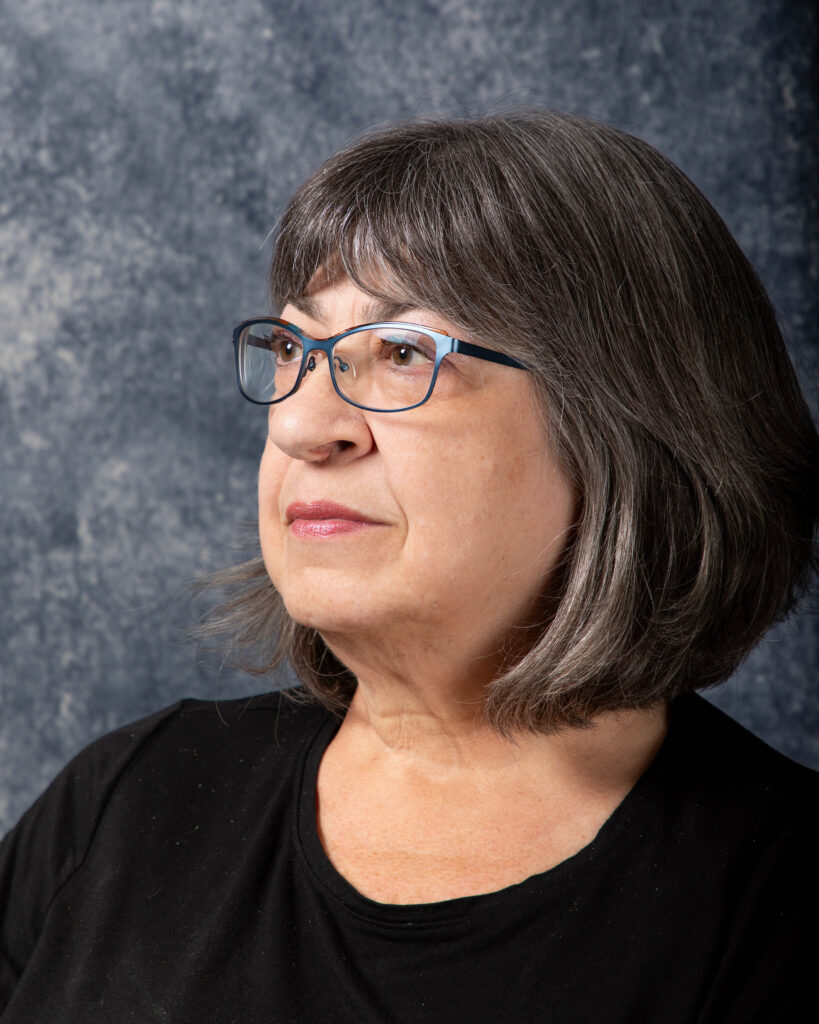

This post presents the resources that Robyn Rennie mentioned during the conversation.
Robyn Rennie
A life-changing vision loss in 2005 has changed how Rennie experience the world. She often continues to choose landscape subject matter, but visual impairment has freed her from her former style of highly-detailed expression, and created a shift toward abstraction and the visceral. While she uses the same medium and grounds, she now employs them to subvert popular assumptions about sight because sight is so highly valued for sensory and aesthetic experience. Interference paints present different colours when viewed from different positions. Colours are created with not only hues but with textures and layers, and invite touch.
Accessible Media Inc. (AMI) – Our Community: Tactile Art (Season 8 Episode 6)
A documentary about Robyn Rennie on AMI. In this episode, Robyn leads a tactile art workshop for the Canadian National Institute for the Blind (CNIB) at Lake Joe camp. The participants of the workshop explored textures and the ideas associated with colours, especially for people who cannot see the colours.
The podcast episode contains an excerpt of this documentary.
Watch Our Community episode on AMI.tv
Exhibition: Art for Social Change
Art for Social Change is a program that uses conceptual art to provide powerful experiences that inspire people to take personal action to create positive change for those facing barriers due to lack of accessibility, inclusion, and other oppressive systems and structures. Seven multidisciplinary artists have been invited to create installations related to the theme of Accessibility. Their artworks were on display at Keyano Theatre and College from December 3 (International Day for Persons with Disabilities) until December 10 (International Human Rights Day), 2025. Artists have partnered with national and local social profit organizations to deepen their understanding of barriers to access, be it physical, mental, neurological, cultural, or otherwise. The goal of this partnership is not only to bring local context to the artwork, but also to show that support exists and we are all on a journey to find solutions.
Robyn Rennie was one of the artists featured in this exhibition.
Learn more about Art for Social Change
Robert Bateman
Born in Toronto, with a degree in geography from the University of Toronto, Robert Bateman taught high school for 20 years, including two years in Nigeria. He travelled around the world in 1957-58, increasing his appreciation of cultural and natural heritage. Since leaving teaching in 1976 to paint full-time, he has travelled widely with his artist/conservationist wife Birgit to many remote natural areas. Bateman has been a keen artist and naturalist from his early days. He has always painted wildlife and nature, beginning with a representational style, moving through impressionism and cubism to abstract expressionism. In his early thirties he moved back to realism as a more suitable way to express the particularity of the planet. It is this style that has made him one of the foremost artists depicting the world of nature.
Visit Robert Bateman’s website
Battle of Cypress Hills
The Cypress Hills Massacre occurred on June 1, 1873, near Battle Creek in the Cypress Hills region of Canada’s North-West Territories (now in Saskatchewan). It involved a group of American bison hunters, American wolf hunters or “wolfers”, American and Canadian whisky traders, Métis cargo haulers or “freighters”, and a camp of Assiniboine people. Thirteen or more Assiniboine warriors and one wolfer died in the conflict. The Cypress Hills Massacre prompted the Canadian government to accelerate the recruitment and deployment of the newly formed North-West Mounted Police.
Learn more about the Battle of Cypress Hills
Tangled Art + Disability
Tangled Art + Disability is dedicated to connecting professional and emerging artists, the arts community, and a diverse public through creative passion and artistic excellence. Our mission is to support Disabled, d/Deaf, chronically ill, neurodiverse, k/crip, Mad, sick & spoonie artists; to cultivate Disability Arts in Canada; and to increase opportunities for everyone to participate in the arts. They do this by developing, showcasing, promoting, and employing Disabled artists, creating partnerships and collaborations that increase opportunities for Disabled artists, empowering Deaf, Mad, and Disability-identified people to embrace and explore their own creativity, and publicly showcasing the rich diversity of talent from the Disability Arts community.
Visit Tangled Art + Disability’s website
Frida Kahlo
Frida Kahlo was a Mexican painter known for her many portraits, self-portraits, and works inspired by the nature and artifacts of Mexico. Inspired by the country’s popular culture, she employed a naïve folk art style to explore questions of identity, postcolonialism, gender, class, and race in Mexican society. Her paintings often had strong autobiographical elements and mixed realism with fantasy. In addition to belonging to the post-revolutionary Mexicayotl movement, which sought to define a Mexican identity, Kahlo has been described as a surrealist or magical realist. She is also known for painting about her experience of chronic pain. Her 1940 self-portrait titled The Dream (The Bed) holds the record for the most expensive work by a female artist ever auctioned at $54.7 million.